Marianne is murdered and her body staged as a prostitute's
Hold TightMarianne is murdered and her body staged as a prostitute’s, a calculated deception that turns the discovery of a victim into a false account of who she was. Left unidentified as a Jane Doe, she becomes the focus of an investigation shaped by the appearance Nash constructed around her. The disguise delays recognition, but it does not hold: Neil Cordova ultimately identifies her, transforming an anonymous murder inquiry into the case of a woman known by name.
The False Identity
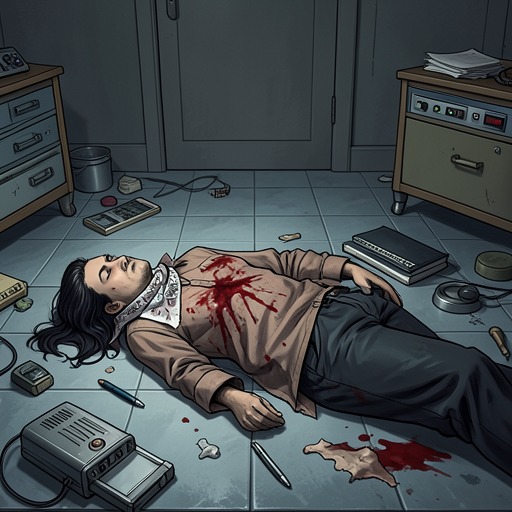
The staging directs investigators toward the assumption that the dead woman was a prostitute. Loren Muse, the Essex County chief investigator handling the Jane Doe case, refers to her as the not-a-whore in the morgue: the phrase marks the distance between the identity suggested by the scene and the person investigators are trying to identify. The point is not simply that the killer concealed Marianne’s name. He supplied a misleading social identity that could steer the investigation toward the wrong account of her life.
That presentation makes the body itself an obstacle to recognition. Nash had left Marianne where the police could find her and had altered her appearance so severely that she could not readily be recognized. He understood that this would make identification more difficult, while also distinguishing his treatment of her from what he intended to do with Reba Cordova. The distinction gives the staging a strategic purpose: Marianne’s body is available to investigators, but the circumstances of its discovery invite them to misread her.
The first investigative steps register how much remains unknown. At six thirty in the morning, Loren checks the homicide board and finds no new killings. She is waiting for fingerprint results from the NCIC, but they have not arrived. A working surveillance camera has been found near the murder scene, and police consider whether it might have recorded the vehicle used to bring the body there. The footage could contain hundreds of vehicles, however, with no obvious way to distinguish the one that matters. These details make the delay tangible: the body has been found, but neither its identity nor the route by which it arrived is yet clear.
A Deliberate Contrast in Concealment
Nash’s handling of Marianne is presented alongside his plan for Reba, revealing that the two cases are connected by the use of false clues but not by identical disposal methods. He believes investigators look for criminal patterns and decides to frustrate that expectation by changing his method. Marianne’s identity, he reasons, can be obscured even though her body has been left for discovery. Reba, by contrast, is likely to be identified if her body is found, so Nash intends to keep it hidden.
He leaves Reba’s car in a hotel parking lot, hoping police will interpret it as evidence that she went there for an illicit encounter and then disappeared with a lover. That manufactured explanation echoes the misleading identity attached to Marianne: in each case, the scene is arranged to encourage an assumption about the woman rather than direct attention to the killer. In Loren’s assessment, the cases share an unusual pattern. Two well-to-do white women in their forties vanish within roughly a day of each other, and in both investigations someone has worked to send police down the wrong track. Marianne is made to look like a prostitute; Reba is made to look like a married woman who ran off with a lover.
The difference is consequential. Nash expects Marianne’s body to generate an investigation, even if it begins from a false premise. He expects Reba’s absence to prevent investigators from connecting her to Marianne at all. He reasons that without Reba’s body, police may have little to pursue and could assume she ran away. His plan depends on separating the cases through their evidence: a discovered, misrepresented victim in one; a missing woman and an apparently suggestive car in the other.
Identification and Reversal
The false identity finally breaks when Neil Cordova sees the Jane Doe and recognizes her as Marianne. His response is immediate and physically visible: he begins shaking, his hand rises to his mouth, and he closes his eyes before naming her. The recognition supplies what the pending fingerprint search has not yet provided. The woman investigators have been treating as an unidentified victim is no longer anonymous to the person standing before her.
That moment reverses the meaning of the earlier staging. The disguise has shaped police attention, but it has not erased Marianne’s identity from everyone who knew her. Neil’s identification replaces the misleading category imposed on her with her name, and the case can no longer be understood solely through the false story presented at the scene. The recognition also makes the human consequence of the deception immediate: the discovery is not only an investigative breakthrough but a devastating confirmation for someone who recognizes the dead woman.
Narrative and Investigative Significance
The event shows how a staged scene can make an investigation proceed through competing interpretations. Loren’s team must work from incomplete evidence: fingerprints are pending, surveillance footage may be difficult to read, and the apparent circumstances of the death point toward a fabricated identity. The later identification does not undo the time spent confronting those false clues, but it changes what they mean. What looked like a victim whose identity fit the scene’s insinuation is revealed as Marianne, a person whose name exposes the limits of that imposed account.
The contrast with Reba’s planned concealment also clarifies Nash’s method without making the two women’s fates interchangeable. He varies the evidence he leaves behind according to what he believes the police will infer. Marianne is found but misrepresented; Reba is meant to remain missing. The cases are linked not merely by proximity in time but by the killer’s effort to control how investigators explain each woman’s disappearance or death. Neil’s recognition punctures that control: the staging can delay the truth, but it cannot permanently decide who Marianne was.